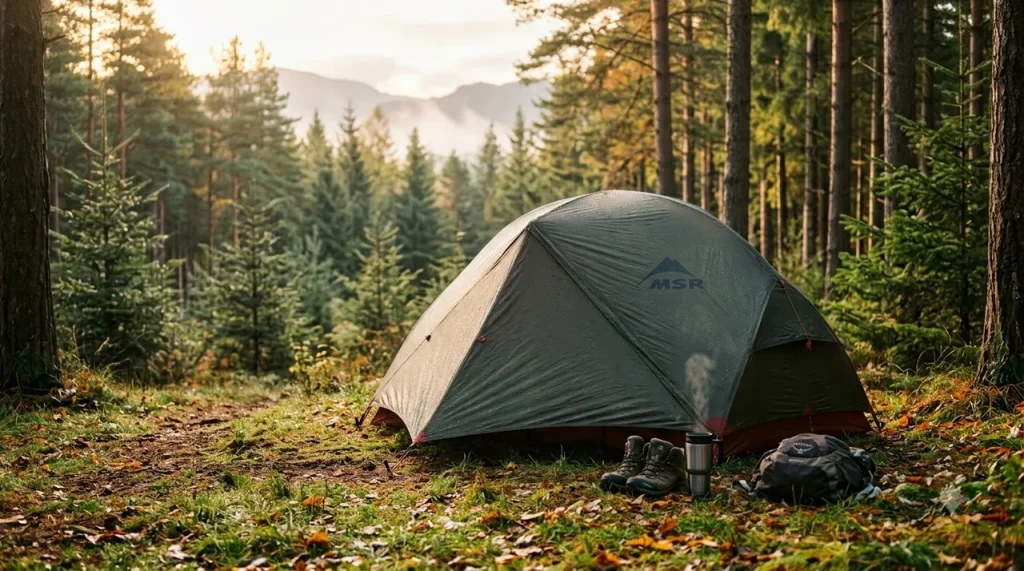
Why Your Tent Gets Soaked Inside on Cold Mornings
Waking up to icy droplets dripping onto your face is one of the most frustrating experiences in outdoor camping. The common assumption is that your tent rainfly leaked during the night, but in over 90% of cold-weather scenarios, the real culprit is interior condensation.
⚡ Quick Takeaway
To prevent tent condensation, maintain active cross-ventilation by cracking apex vents and pitching guyouts tautly to preserve a 2 to 4-inch gap between the rainfly and inner mesh.
A single adult exhales roughly 16 to 32 fl oz (0.5 to 1 liter) of water vapor overnight. When this warm, moisture-laden air contacts cold tent fabric chilled below the dew point, it instantly condenses into liquid water.
Understanding tent physics is straightforward: tents do not generate insulation through solid fabric; your sleeping pad and sleeping bag provide thermal retention. Sealing every zipper shut to “trap heat” only traps humidity, converting your shelter into a high-moisture terrarium by dawn.
At-a-Glance: Moisture Sources vs. Corrective Actions
Before adjusting your setup, identify where humidity originates inside your shelter. Every human body, damp garment, and square foot of unsealed ground introduces moisture into the enclosed airspace.
The goal is not to eliminate humidity completely, as breathing is mandatory. Instead, the strategy relies on creating continuous air turnover so moisture escapes before it touches freezing surfaces.
4 Essential Ventilation Fixes for Crisp, Dry Mornings
Executing precise airflow management transforms damp mornings into dry, comfortable wakeups. Follow these four structural adjustments when setting up your shelter in near-freezing or humid weather.
Deploy the Chimney Effect (High-Low Airflow)
Open kickstand vents at the peak of your rainfly while propping lower perimeter vents open. Warm breath naturally rises; by giving it an escape hatch at the ceiling, cooler and drier outside air is drawn in from the base, flushing moisture continuously.
Maximize Rainfly Tension and Guyline Spacing
Never let your outer rainfly touch the inner mesh wall. Stake every guyline at a 45-degree angle with high tension to establish a uniform 2 to 4-inch buffer zone. This air corridor prevents moisture transfer and permits cross-breezes between layers.
Utilize Two-Way Vestibule Zipper Vents
If your vestibule has two-way zippers, pull the top slider down 4 to 6 inches beneath the protective storm flap. This creates an upper convective port that vents exhaled steam without exposing the sleeping bay to rain or snow flurries.
Align the Shelter Axis With Prevailing Wind
Orient the smaller profile or dedicated vent side of your tent directly into the night breeze. A steady 3 to 5 mph gentle draft across the rainfly generates negative pressure, pulling stale humid air out from inner compartments.
💡 Pro Tip
Silnylon fabrics stretch up to 10% when wet and cold. Always re-tension your guyline cords right before crawling into your sleeping bag at night to eliminate mid-slumber rainfly sagging.
Campsite Selection: Microclimates That Make or Break Airflow
Where you pitch your tent often dictates condensation levels more than the tent design itself. Terrain features create distinct microclimates with drastically different dew points and ambient humidity levels.
Ideal: Forest Canopy & Elevated Benches
Pitching beneath mature trees provides a thermal ceiling that reduces radiant heat loss to the night sky. Elevated ground prevents cold air pooling and catches light, drying breezes.
Avoid: Valley Basins & Riverbanks
Cold, dense air drains into depressions and sits stagnant near water bodies. These thermal sinks create 95%+ relative humidity, guaranteeing saturated tent walls regardless of ventilation.
Even a minor elevation shift of 15 to 30 feet above a riverbed can raise the surrounding temperature by 3°F to 5°F. This small variance is frequently enough to keep tent fabrics above the dew point threshold, keeping internal walls completely dry.
Critical Mistakes That Cause Tent Rain and Misting
When wind shakes heavy condensation loose from a rainfly, fine water droplets spray through the ceiling mesh—a phenomenon backpackers call ‘tent misting.’ This issue is almost always amplified by common camping habits.
⚠️ Caution
Never pull your head inside your sleeping bag to stay warm. Tucking your face inside funnels 100% of your moisture-laden breath directly into down insulation, collapsing the loft and severely destroying its insulating ability.
📋 Camp Moisture Control Checklist
✔ Ensure the ground footprint is 1 to 2 inches smaller than your tent floor so rain does not pool underneath.
✔ Pack a compact synthetic microfiber pack towel inside your tent pocket for a 30-second wipe-down before breaking camp.
✔ Maintain a loose balaclava or fleece beanie over your face instead of breathing inside your sleeping cocoon.
By treating condensation management as an active campsite routine rather than an afterthought, you ensure your down sleeping bag and thermal layers stay bone dry through multi-day backcountry trips.
Expert Verdict: The Ultimate Cold-Weather Condensation Protocol
Camping in cold weather requires embracing a simple law of outdoor physics: ventilation trumps insulation at the tent wall level. Relying on an ultralight tent fabric to retain ambient heat is ineffective; your warmth must come exclusively from a sleeping pad with an ASTM R-value of 4.0+ and an appropriately rated 20°F or lower sleeping system.
When pitching in conditions between 25°F and 45°F, lock down your routine: choose elevated terrain under light forest cover, stake guylines tautly to guarantee a 3-inch gap, crack both high and low vents wide open, and keep damp equipment quarantined in the vestibule.
Adopting these four ventilation fixes eliminates morning ceiling drizzle, protects high-loft down gear, and guarantees a dry, warm start to every wilderness day.
Frequently Asked Questions
Does cracking tent vents in cold weather make the tent colder?
Tents provide minimal thermal insulation—usually raising ambient temperature by only 2°F to 5°F at most. Closing vents traps moist air, which makes you feel significantly colder because humid air pulls heat from your body faster. Leaving vents open keeps internal air dry, helping your sleeping bag insulate effectively.
Is single-wall or double-wall better for preventing condensation?
Double-wall tents are vastly superior at managing condensation for general camping. While condensation still forms on the underside of the outer rainfly, the breathable inner mesh barrier prevents your body and sleeping gear from accidentally contacting the wet surface.
Why does my tent still get wet inside when it hasn’t rained?
This happens due to radiant cooling and respiration. As ambient temperatures drop at night, moisture from your breath and the surrounding air condenses on the cold nylon fabric once it drops below the dew point, creating interior liquid without a single drop of rain.
How do I dry a wet tent fly quickly while backpacking?
Wipe down the interior of the rainfly with a small microfiber pack towel before packing. Store the wet rainfly in an external backpack pocket separate from your inner tent and sleeping bag, then lay it out in the sun during a 15-minute lunch break.
References and Links
- REI Expert Advice: How to Prevent Condensation in a Tent
Comprehensive outdoor guide exploring airflow dynamics, campsite selection, and structural tent venting methods. - Sea to Summit: Managing Tent Condensation
Technical insights on moisture output from breathing, fabric performance, and ventilation positioning.
👉 Related: Camp Kitchen Organization: Essential Gear and Storage Setup
👉 Related: Compact Camp Kitchen Cookware: Essential Outdoor Cooking Gear