Why Your Serums Pill and How to Fix It Fast
⚡ Quick Takeaway
Apply Hyaluronic Acid first to damp skin, wait 60 seconds, then gently press Niacinamide on top.
Pilling happens when excess polymers, thickeners, or silicones clash and ball up under friction. Using only 2 to 3 drops per product and pressing instead of rubbing eliminates flakes completely.
Nothing is more frustrating during your morning skincare routine than feeling little rubbery flakes form across your cheeks. That unpleasant texture is known as skincare pilling. It happens when active formulas fail to penetrate the stratum corneum and instead roll off into tiny clumps.
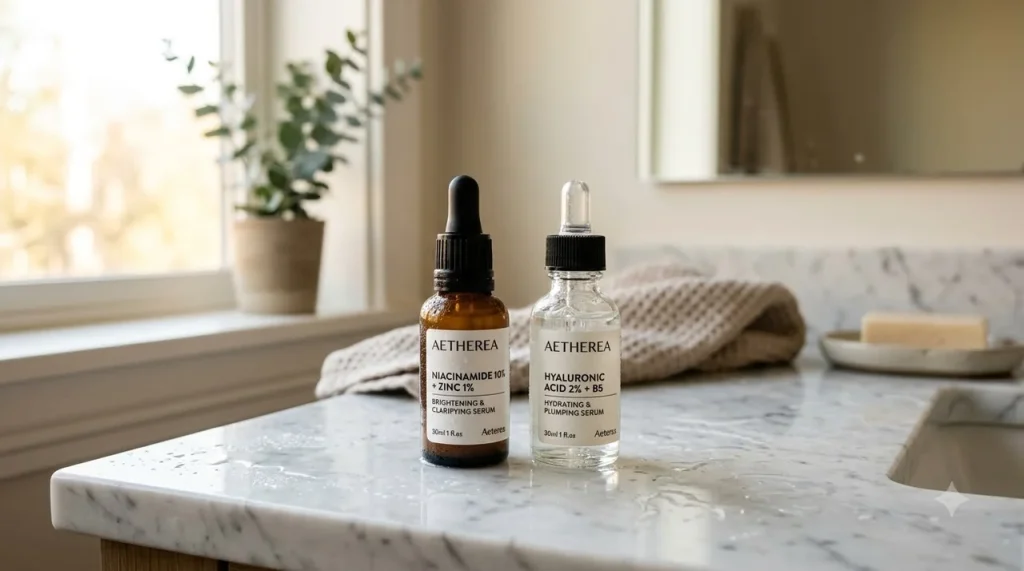
Combining niacinamide (vitamin B3) and hyaluronic acid (HA) is one of the most effective ways to balance sebum production, repair the moisture barrier, and plump dull skin. However, because both actives frequently rely on viscous thickening agents like xanthan gum and carbomers, layering them incorrectly creates instant surface friction.
Hyaluronic Acid vs. Niacinamide: Formula Comparison
To stop skincare from balling up, you must understand how each ingredient behaves at the molecular level. Hyaluronic acid acts as a powerful humectant that draws ambient moisture into the surface layers of your skin, while niacinamide functions as a water-soluble restorative vitamin.
When these two formulas meet without proper spacing, high molecular weight polymers cling to one another. Understanding their individual requirements helps prevent unwanted texture clashes before you apply your daily moisturizer.
Step-by-Step Guide: How to Layer Niacinamide and Hyaluronic Acid
Following the correct sequence ensures each ingredient absorbs into your dermal layers without shedding. Here is the foolproof 4-step application method verified by aesthetic specialists:
Cleanse and Mist
Wash with a gentle pH-balanced cleanser (around pH 5.5). Lightly spritz your face with pure water or an alcohol-free hydrating toner so your skin remains dewy.
Apply Hyaluronic Acid (2 to 3 Drops)
Dispense 2 to 3 drops of hyaluronic acid serum onto your fingertips. Gently pat and press it across damp skin. Allow 45 to 60 seconds for the moisture web to bind.
Press Niacinamide Serum In
Dispense 2 to 3 drops of your 2% to 5% niacinamide serum. Press the liquid into the skin using flat palms rather than rubbing back and forth.
Seal With a Compatible Moisturizer
Wait 60 seconds, then lock in the actives with a ceramide-rich cream or lightweight gel lotion to prevent trans-epidermal water loss.
💡 Pro Tip
If you are in a rush, look for a 2-in-1 hybrid serum that formulates 5% niacinamide with multi-molecular hyaluronic acid in a single lab-stabilized base.
Application Technique: Patting vs. Rubbing
The friction you apply with your hands is the primary mechanical trigger for pilling. Vigorous circular rubbing breaks down polymer bonds before the actives can penetrate your pores.
Pressing & Patting Technique
Maintains the delicate film balance, boosts skin microcirculation, and prevents surface clumps from gathering.
Circular Rubbing Technique
Creates shear stress that shears polymers off the skin, generating immediate eraser-like debris.
Always distribute the serum evenly across both palms, then press firmly against your forehead, cheeks, and neck for optimal absorption without physical dragging.
Common Layering Mistakes to Avoid
Even experienced skincare enthusiasts make routine mistakes that cause formulas to roll off. Being mindful of formula chemistry and product amounts will save both product and time.
⚠️ Caution
Never apply hyaluronic acid directly to completely dry skin in low humidity environments. Without surface water, it draws moisture from deeper skin layers and creates an unstable, chalky barrier.
📋 Anti-Pilling Routine Checklist
✔ Maintain a 45 to 60-second resting window between layering steps.
✔ Check ingredient labels for heavy silicones like dimethicone in early serum steps.
✔ Exfoliate 1 to 2 times weekly with gentle AHA/BHA to clear dead cell buildup.
Eliminating excess serum volume is usually enough to resolve pilling on its own. Using half a dropper on each cheek over-saturates the epidermis, leaving an unabsorbed film that inevitably sheds when touched.
Dermatologist Verdict & Product Synergy
Board-certified dermatologists widely endorse pairing niacinamide and hyaluronic acid because they share complementary physiological targets. Hyaluronic acid supplies immediate hydration to the outer stratum corneum, while niacinamide stimulates natural ceramide synthesis to strengthen the lipid barrier long term.
When incorporated properly into your AM and PM regimens, this duo minimizes the appearance of enlarged pores, balances excess sebum, and produces a smooth canvas for makeup and broad-spectrum sunscreen. Consistency, gentle pressing, and adequate dry-down intervals are all you need for glass-like results.
Frequently Asked Questions
Which goes first, niacinamide or hyaluronic acid?
Apply hyaluronic acid first onto freshly cleansed, damp skin. Once it absorbs for about 45 to 60 seconds, apply your niacinamide serum. Following this sequence prevents moisture loss and ensures both formulas penetrate effectively without pilling.
Can I mix niacinamide and hyaluronic acid together in my hand?
Yes, you can mix 1 to 2 drops of each in your palm before applying if both formulas are water-based. However, applying them in separate layers with a brief pause often delivers better absorption and reduces texture conflicts.
Why does my sunscreen pill after applying niacinamide?
Sunscreen pills when previous serum layers have not completely dried or when silicones in your sunscreen clash with film-forming agents in your niacinamide. Allow your moisturizer to set for 2 full minutes before pressing your sunscreen on gently.
Does high percentage niacinamide cause more pilling?
Yes. Formulas containing 10% to 20% niacinamide often leave a crystalline or powdery residue as the water evaporates. Dermatological studies show that 2% to 5% niacinamide offers full clinical benefits with a significantly lower risk of pilling and skin irritation.
References and Links
- American Academy of Dermatology (AAD) – Skincare Layering Tips
Clinical guidelines on proper skincare order and barrier maintenance techniques. - Journal of Cosmetic Dermatology – Niacinamide & Skin Barrier Function
Peer-reviewed research detailing the ceramide-boosting synergy of topical niacinamide. - National Center for Biotechnology Information (NCBI) – Hyaluronic Acid Overview
Scientific analysis of hyaluronic acid molecular weights and moisture retention capacity.
👉 Read Next: Morning vs Evening Skincare Routine: Dermatologist Guide
👉 Read Next: 5-Minute Daily Skincare Routine: Fast Morning Sun Protection